


The network is supported by Whitelabel.ai, an AI native fundraising platform. Clients include Livestrong, the Canadian Red Cross, Net Impact, and Hunger Free Colorado.
💭 Thought for the week: Learning from Anthropic
On September 17th, Anthropic, the company that builds Claude, published an article worth reading, as an attempt to answer the million-dollar question, how fast is AI actually moving?
The headline findings suggest; very fast. Claude now leads more than a quarter of Anthropic’s own AI research and development work – up from under 1% seven months earlier. But there’s a more interesting finding buried underneath that one. So yes, Claude now leads 26% of Anthropic’s own AI research tasks and collaborates on over 90% of the rest. This sounds like a lot, until you notice what it isn’t: full autonomy. In Anthropic’s own scale, that’s AL3 and AL4 - human-guided and human-supervised. Not AL5. Even inside the lab writing the frontier, every agent action still passes through a monitor, in real time and after the fact, with anything flagged going straight to a person.
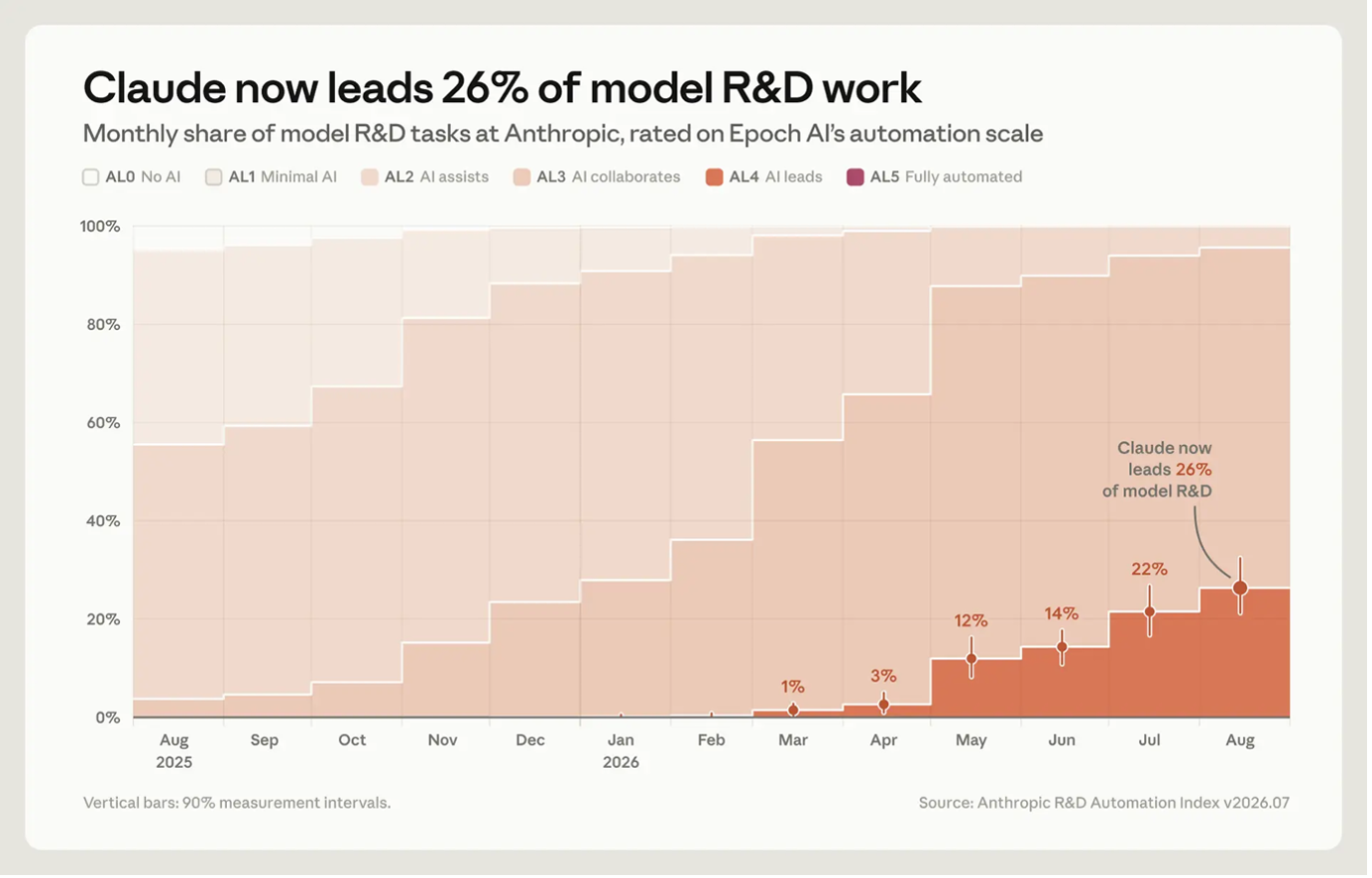
No one at Anthropic is on autopilot; a monitor checks every action an agent takes before it runs, and another reads it again afterward. About one in 47,000 actions gets blocked. Around 50 flags a week go to a person. This is the company building the frontier, and a human still signs off.
Anthropic says it will embed independent evaluators from several outside organizations inside the company, with the same access to systems and data as its own risk teams. The bet is that being checkable is worth more than being impressive.
You already run this way. Your finance team doesn’t audit itself. Your gift acceptance policy decides what comes in before anyone banks it. Your board reviews what staff propose. The labs are spending engineering budgets to build that same setup: something acts, something checks, and a named person decides. Donors already hold you to that standard, so extending it to AI is a smaller step than it looks.
Anthropic’s own numbers show that oversight is not what slows AI down – it’s what lets it move fast safely. The labs are proving that you don’t need to choose between caution and speed. The non-profits getting ahead right now aren’t the ones waiting, they are the ones building the oversight in now, so speed doesn’t have to wait for later. In partnership with Whitelabel, our six cohorts are already testing human in the loop donor journeys.
🧪 From the cohort
Our six cohort organizations are working on exactly this right now: AI-built donor journeys where a staff member approves each step before it reaches a supporter. We’re tracking what the review step catches and what it changes. The results go out in December, failures included. Want in on cohort two? Join the waitlist.
🪟 AI transparency
This is where non-profits already have an edge most labs are still building toward. Frontier labs are spending real budget and engineering effort just to keep AI aligned with human intent. Non-profits already run on ethical frameworks, stakeholder accountability, and mission clarity. That is the underlying muscle for exactly this kind of governed, high-oversight AI use. You’re not starting from zero on this part. This matters doubly because of trust. Anthropic’s whole argument for self-reporting is that trust requires verifiable transparency, not just a good-faith claim. Non-profits live and die by that same standard with donors and beneficiaries - you can’t afford a reputational hit any more than a frontier lab can afford a broken safety claim.
What you can do:
Map one workflow. Take your gift thank-you process and mark each step as AI drafts it, AI does it and a person checks, or a person does it alone. That’s Anthropic’s method, scaled to your team.
Name the reviewer. Give every AI step a named person and a turnaround time. Anthropic reviews blocked actions within a week, and you can beat that.
Ask vendors three questions before you ask about price. What does your system check before it acts? What gets escalated to a person, and how fast? Who outside your company has checked your numbers?
📣 Worth a look
Seattle area only: Microsoft’s $1M Community-First Grants. These are open to King County 501(c)(3)s that don’t already receive Microsoft funding. The money covers facilities, housing and basic needs, workforce, and sustainability, not AI specifically. The first round closes October 23, and decisions come in November.
Philanthropy is pricing in the AI windfall. Coefficient Giving raised its 2026 commitment to GiveWell-recommended charities from $175 million to $1 billion. It says openly that it’s betting on OpenAI and Anthropic going public and creating a new wave of tech donors, and it wants charities ready to absorb that money. So ask yourself: if a newly wealthy engineer lands on your donation page next year, would your data flag them as a $10k conversation or a $100 ask? (Chronicle of Philanthropy, Sep 1).
The Anthropic comparison has an asymmetry worth naming. Their monitor is automated, which is why only around 50 flags a week reach a person. Name the reviewer puts a human on every step instead, so the load scales with volume rather than with exceptions.
Worth tracking alongside what the review catches: how long an approval takes in week one versus week ten. If that time collapses, the review has quietly become a rubber stamp while the diagram still says human in the loop.