


The AI for Non-Profits Network is supported by Whitelabel.ai, an AI native fundraising platform. Clients include Livestrong, the Canadian Red Cross, Net Impact, and Hunger Free Colorado.
Free workshop on personalized campaigns, and unlocking them inside your CRM, runs 23 September at 11am ET. Reply to this email to sign up.
💭 Thought for the week
On September 6, OpenAI published An Alien Mind, by its chief scientist Jakub Pachocki. It’s a safety paper, mostly about alignment and the pace of capability. Buried in it is a line about preventing “extreme concentration of power in a world where undertakings that would have taken thousands of experts now will be achievable by a few people operating a large computer.”
Whilst that might be a warning about machines, you could equally transfer it to a rate of change within your organization.
Technology isn’t waiting around for us to catch up. Every year an organization sits on the sidelines, the gap widens between teams equipped to move fast and everyone else. Nonprofits almost always end up on the wrong side of that divide. We know the drill: tight budgets, painful hiring cycles, and a decade of irreplaceable institutional knowledge trapped inside the heads of just three or four key people.
That isn’t a reason to sit back. Work that used to take a full team is suddenly doable with a small group. The real question is: What does your team already know how to do that could move at that speed?
Remember when AI in the social sector was just a debate over ChatGPT policies? Now, cost isn’t the barrier and prompts are old news. A single model can parse your entire donor file, case history, and operating policies in seconds. The real constraint isn’t the technology anymore, it’s that most teams still haven’t figured out data privacy rules or who takes ownership when the system makes a bad call.
So the constraint is no longer the model. It’s whether anyone has organized the knowledge, the governance and the workflow for it to act on.
We covered the peer-learning paper from the OpenAI Foundation’s first grantee cohort in the 07/21 briefing, and the pattern held across them. The ones who moved fastest weren’t the ones who adopted the newest tool. They were the ones who already had something they did well, and asked what it could become. Here’s a closer look at one, from a week we spent inside it.
🔍 A worked example: employee ownership
Last week we were with Project Equity at the EO Equals Summit in Chicago.
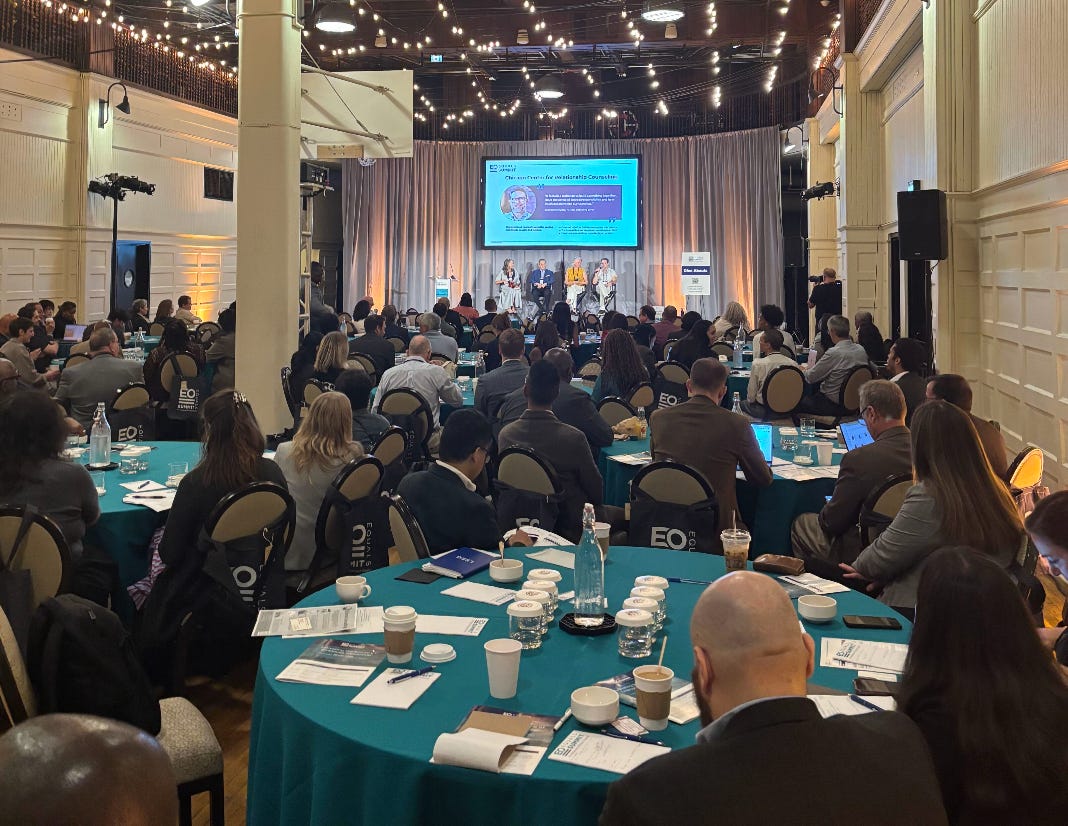
Project Equity works at the front lines of the “Silver Tsunami”, helping retiring business owners transition their companies to employee ownership rather than closing up shop or selling out to private equity. Three lessons come out of what they’re doing, and none of them are about employee ownership.
Start with the scale of what they’re working against. McKinsey’s Institute for Economic Mobility published The Great Ownership Transfer in February. The stakes couldn’t be higher: McKinsey estimates that roughly six million U.S. small businesses will change hands over the next decade. In 2022 alone, 510,000 business owners exited, and a staggering 92% of those businesses simply closed. Transitioning even a fraction of them to employee ownership would keep up to 12 million jobs right where they belong and preserve $5 trillion in local wealth.
The report gets straight to the point on why employee ownership hasn’t taken off faster: the models stay “underutilized because of limited technical capacity, inconsistent policy frameworks, and a lack of standardized transition infrastructure.”
Zero in on that first phrase: limited technical capacity. This isn’t a lack of interest or a failure of belief. It’s simpler and more frustrating than that: there just aren’t enough people who know how to structure these deals, and teaching someone takes years.
Substitute your own cause and see whether it still reads true. Benefits screening, housing navigation, immigration advice, clinical supervision, arts fundraising. Across most of the social sector, the real bottleneck isn’t a lack of need or conviction. It’s that critical expertise lives inside a tiny group of people and can’t be copied fast enough.
That’s the constraint AI is genuinely good at, and it’s a different project to the one most of the sector is running. Most of that effort points at direct donor fundraising. Much less points at the knowledge base, where the sustainable revenue actually sits.
🌳 What they did with it
Project Equity didn’t start an AI program.
They brought over a decade of hard-earned, on-the-ground experience with hundreds of closed deals, valuation models, and custom governance structures. A lot of that know-how was already wrapped into training for business owners and certifications for the advisors who guide these deals. Funded by the OpenAI Foundation’s People-First AI Fund, they asked what that decade plus of experience could become at a different rate and scale.
They built two things, neither of which is a generic chatbot sitting on a homepage:
Adaptive Advisor Training: Instead of dragging every advisor through the exact same static modules, the platform adjusts to what someone already knows, zeroes in on where they’re struggling, and gets them certified much faster.
Real-Time Deal Intelligence: With over a decade of transaction history, every valuation and deal structure is now an active reference engine. When an advisor works through a live transition, the platform surfaces past benchmarks and practical guidance right when they need to make a call.
Full disclosure: Project Equity built this platform alongside Whitelabel, who sponsors this newsletter. We have skin in the game, so judge it accordingly.
Look at what makes this work:
Irreplaceable institutional knowledge that the organization already owns.
A human bottleneck that caps how many businesses they can help transition.
An audience of advisors and partners willing to pay for access, turning a mission-driven service into a reliable revenue line instead of an endless grant chase.
If you’re reading this and thinking your work doesn’t sound like an AI project, good. Project Equity’s doesn’t either. It sounds like strong business succession advice.
🔄 Now reframe it to your cause
What do you know that takes years to teach? Not your mission statement. The operational judgment - how your caseworkers spot a fraudulent claim, how your grant writers read a funder, the pattern recognition that walks out of the building when someone leaves.
Where’s the bottleneck between that knowledge and the people who need it? Usually a few experienced staff and a waiting list. Name the number. How many people are you not reaching because four people can only do so much?
Who would pay for access to it? Peer organizations, advisors, public agencies, funders who currently pay you to deliver the service and would pay more to have it scaled. This is the question the sector avoids, and it’s the one that turns a grant-funded program into something that sustains itself.
If all three have answers, you’re looking at the same project Project Equity is running, in your own field. Ask yourself this today: if you had to run the next twelve months at Pachocki’s rate, on the single thing your organization does better than anyone else, what would you build, what would it cost, and what would it earn?
Nobody knows where this lands in two years, and anyone selling you a confident answer is selling something. But not knowing the destination is a poor reason to stay where you are. None of us are at the front of this - the gap worth worrying about is between the organizations on the curve and the ones still discussing whether to get on.
Reply and tell us a few of your ideas. We’ll publish the best of them.
📊 What we’ll report back
We’ll follow how Project Equity gets on through the year and share the lessons when they launch. What moved, what didn’t, where the model held and where it needed a human. Same standard as the cohort work.
Are you a business owner exploring succession or an advisor guiding transitions? Learn how employee ownership preserves business legacies, protects local jobs, and keeps community wealth where it belongs. Explore Project Equity’s tools and advisor network here.
👋 Two ways in
Our free workshop on personalized campaigns, and unlocking them inside your own CRM, runs 23 September at 11am ET. Reply to this email to sign up.
And the waitlist for cohort two is open - same structure as the first, real deployments with findings published as they emerge. Reply with your file’s state and we’ll advise honestly whether it’s your next move or whether something else should come first.
The AI for Non-Profits Network is supported by Whitelabel.ai - relevance over volume, personalized supporter journeys, AI-powered giving at small-org scale. Just reply to this email.
🌎 Other things worth attending
Responsible AI in patient and caregiver support - September 16, 11:30am ET. Jon Florin (No Stomach For Cancer) and Jak Spencer (Whitelabel AI) on responsible AI in patient and caregiver support - consent, transparency, opt-outs, and who gets a say in how patient data is governed. Real examples and questions. Register here.
The Project Equity example works partly because the knowledge was already half structured: training modules, certifications, hundreds of closed deals. For most organizations the first job is not building anything, it is that the operational judgment has never been written down at all. Nobody has recorded how a caseworker spots a bad claim, because it happens in two seconds and looks like intuition. That is usually a few weeks of sitting with the four people and capturing decisions, not documents. And once it is encoded, someone has to own the calls the system gets wrong. That is a real role, not a footnote in the rollout plan.