


This newsletter is supported by Whitelabel.ai, an AI native fundraising platform. Clients include Livestrong, the Canadian Red Cross, Net Impact, and Hunger Free Colorado.
💭 Thought for the week: sorting the inbox
Some supporter exports from our six cohort organizations started arriving in the second half of September, and every one held more than the organization had told us to expect. Some had built segments years ago and never used them. Most had far more contacts than anyone had mentioned.
That gap is common, and we think it’s where AI helps a small team fastest. The information is already there, in the inbox, the CRM and old exports, and every message says something about what a supporter cares about or why they gave. Nobody on a small team has time to read it all, so it sits. You’re not mismanaging anything by leaving it there; there just aren’t enough hours.
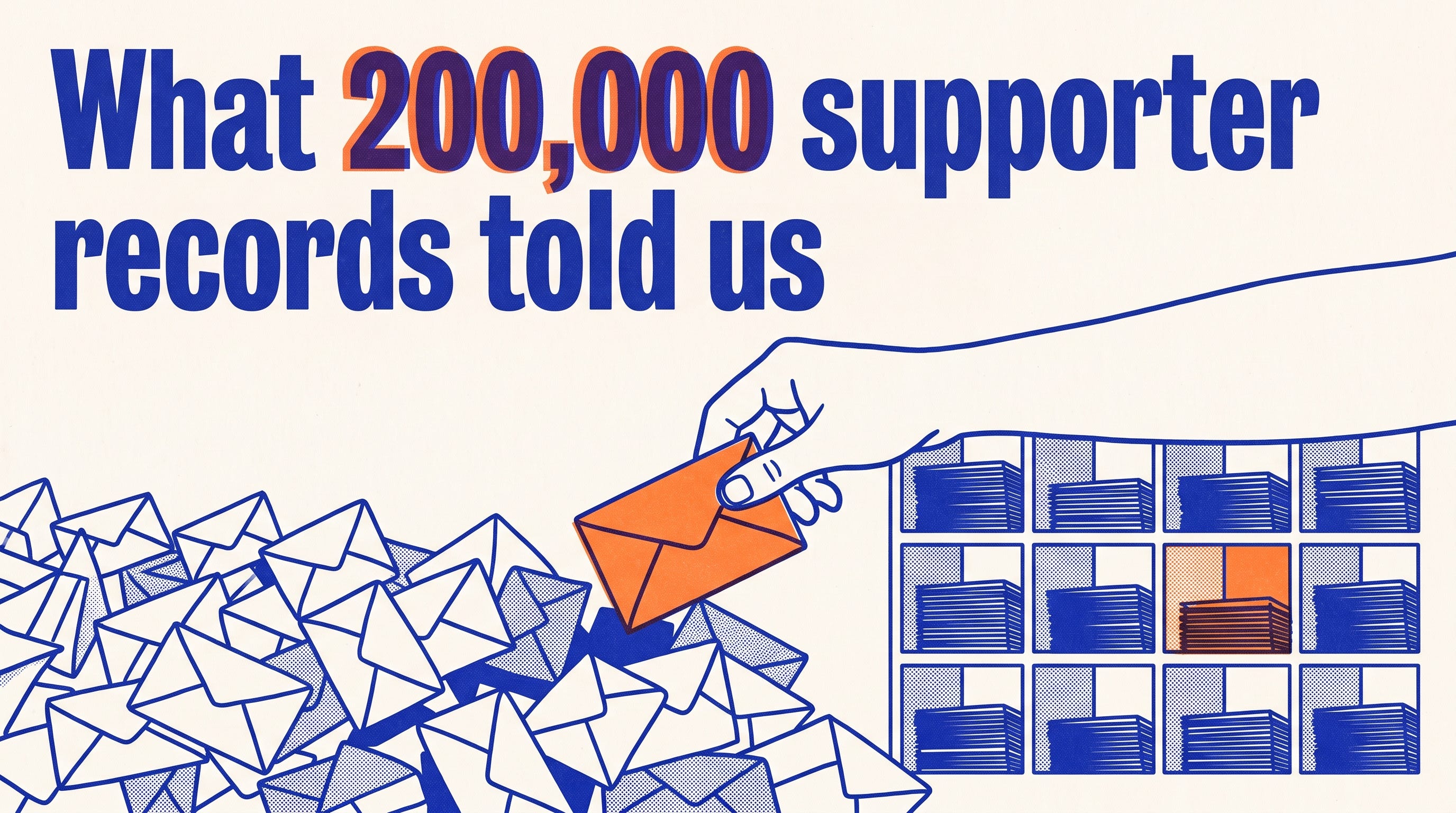
It does cost something, though. Across the records analysed was more than $4.7 million in recorded giving, and less than 1% of it had come in by email - the cheapest channel any of them has. We doubt supporters are ignoring email. It’s more likely nobody had the time to work out who to write to, or what to say.
The AI sorts; people decide. The data stays inside secure tools, and nothing goes to a supporter until someone on the team has checked it. If a donor took the time to explain why they give, a person should read that before anyone replies.
Your move this week: sort 100 emails
You can do a version of this yourself. Pull 100 recent emails from your shared inbox into an AI tool your organization already trusts with supporter data, decide what you want to find out, and start with questions like these:
Which came from donors, and which from people who’ve never given?
Who asked a question, and which questions went unanswered?
Who has given consistently over several years?
Do several donors work for the same employer? List any that appear more than twice.
Which emails mention a personal reason for giving, like a local connection or a family member?
Even a small batch usually turns something up. If several people are asking the same question, your FAQ is missing an answer. If three donors work for the same company, check whether that employer matches gifts. Many large employers do, and the money often goes unclaimed.
🧪 From the cohort: what the records showed
Put together, the cohort’s records covered more than 200,000 people, and fewer than one in a hundred had a gift on record.
Of the roughly 1,600 donors, two in three hadn’t given in the past year. Lapsed donors are hard to win back - only about 3% return in a given year (Fundraising Effectiveness Project) - so we’re leaving them for later. The first messages go to 69 people, about 4% of donors: those who’ve started to cool, and those who made a first gift in the last 90 days and might still make a second.
Monthly giving showed the widest gap between the research and what organizations were doing. M+R Benchmarks finds 71% of monthly donors still giving a year later, against 24% of new one-time donors. Across the records, fewer than four donors in a hundred give monthly.
The largest group had never been asked at all. For every donor there were more than six people with a real connection to the organization, such as alumni, families who’d used a program or engaged subscribers, who had never given. Some had even said they wanted to. For people like that, the evidence point away from leading with money: emails asking for an action get a 1.4% response, against 0.05% for a donation ask. So the first message asks them to do something, and the request for a gift comes later.
We’ll report back once the first messages have gone out and we can see what they produce.
🚀 Join the second cohort
The Cohort 2 waitlist is open: Join the Cohort 2 waitlist here. It runs like the first, with five months of real deployments and findings. We’d especially like to hear from organizations with a dormant list, a big pledge file, or an audience they’ve never asked for money.
Try the 100-email exercise and reply to tell us what you found: hello@aifornonprofitsnetwork.org
Worth a look
Meta’s Muse, for your personal inbox. Meta launched Muse on September 8. It’s a free AI agent that reads and drafts email. We’ve tested it on clearing spam and pulling up the messages that need a reply. It’s also three weeks old, and Inc. has reported it syncing message history a user hadn’t given it access to. Try it on your own email if you’re curious, but keep supporter data in tools your organization has vetted.
China and the US start talking about AI risk. On September 14 China published version 3.0 of its AI Safety Governance Framework. It now lists 54 risks, up from 30, including tool poisoning, identity spoofing and memory contamination in AI agents, and its main safeguards are human sign-off and phased rollout. Six days later, US Treasury Secretary Scott Bessent and Chinese Vice Premier He Lifeng agreed to set up a US-China AI dialogue, with a proposed channel for warning each other about AI incidents serious enough to raise national security concerns. For nonprofits, the list is the useful part. The agent risks it names are good questions to put to any AI vendor, and human sign-off with a gradual rollout is how the cohort works too.
Whitelabel.ai helps nonprofits read what they already hold about their supporters, with a person in charge of what happens next.
The 100-email exercise is worth running. One thing worth doing first: check for duplicate people across the sources. When a CRM export, a shared inbox and an old segment file get combined, the same person often appears two or three times under different emails, and their giving history splits across the copies. That inflates the headcount and can keep someone out of the 69 who belongs there. A pass on email plus last name usually catches most of it.
I love this simple exercise. So many nonprofits miss a huge opportunity by not taking the time to analyze the data they have a their fingertips. While I'm proactive about human first communications, using AI to mine data and draw out insights is a quick and effective method to understand your donors and public.