

We have been partnered with Whitelabel for some time now and while AI for non-profits organization remains dedicated to being an unbiased platform to help all, the partnership has meant we have seen some of their work and their evidence bank is something genuenely worth spotlighting.
So much fundraising advice is based on folklore. It is the unfortunate reality of an underfunded and under researched sector. The issue here is that AI doesn’t always know the difference. Unless told otherwise, AI repeats what sounds plausible, so if the myths are out there, they end up in donors’ inboxes.
Through our partnership with Whitelabel we’ve seen the evidence bank behind their platform, and it’s worth spotlighting because it’s built to stop exactly that. I spent this week unpicking how it works.
In short
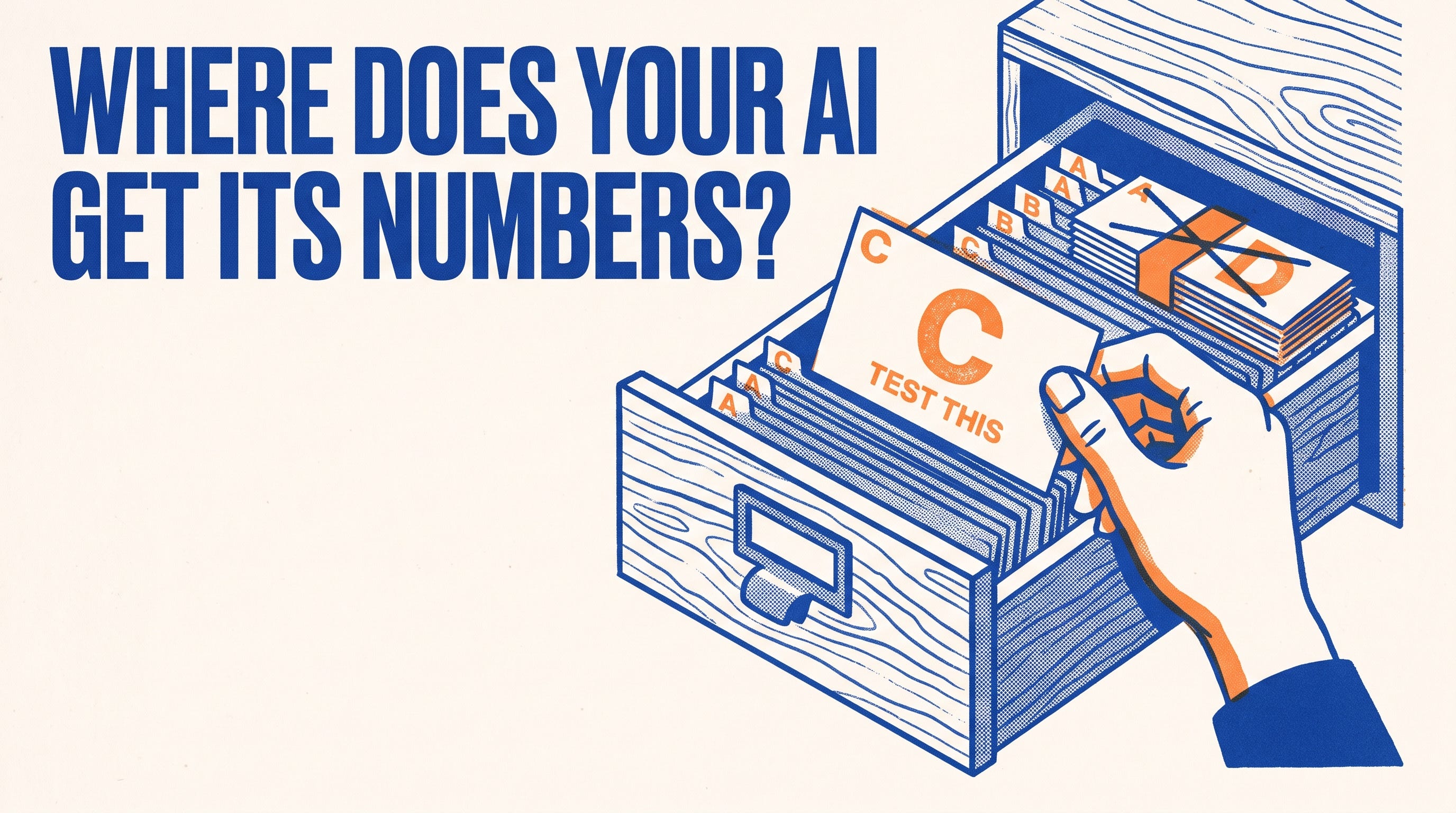
The bank holds around 200 claims that the platform’s AI is allowed to lean on. Each one is graded:
A: a proper experiment or an official sector benchmark
B: credible independent research
C: vendor research or experienced practitioners’ judgement. These can only ever be presented as “test this on your own data.”
D: a block list - retired myths and commonly misquoted figures. This keeps the AI away from the folklore.
Every figure the AI uses comes word for word from the bank, with its source and grade attached.
The D list is interesting. It holds a few dozen claims, retired myths and commonly misquoted figures that the AI is explicitly kept away from. Telling an AI what not to say matters as much as telling it what to say.
The bank sits behind everything on the platform: the chat agent, missions and insights. It also supplies the benchmarks an organization’s own numbers are measured against. With the second gift rate, for example, the bank holds a benchmark of roughly 19% for the share of first-time donors who give again. If an organization falls below that figure, Whitelabel’s AI flags it and suggests a one-click fix, such as ‘Start a mission to lift our second gift rate’.
Getting that second gift is one of the things our cohort is testing right now.
Journeys
Most nonprofits we speak to want one of two things from AI: donations or volunteers, and often both. Volunteers get their own funnel backed by its own evidence, so a volunteer campaign is held to the same standard as an appeal. Donors and volunteers are labelled in the contact list and treated accordingly.
Most journeys, though, are donor journeys, from someone’s first gift to the point where they give steadily. Supporters are grouped by their actual giving behavior, read from the record rather than guessed by the AI. Each group carries its own evidence, and what the AI does next depends on both the group and how recently that person gave. Anything the AI isn’t confident about, or that touches sensitive data, goes to a human.
Let’s simplify this with a real life example.
Juliet donates $50 every 6 months to her local food bank and has done so for the past three years. Her most recent donation was 5 days ago. Juliet will be tagged in the system as a steady donor in her campaign profile. AI will then use the evidence bank with benchmarks and guidance on steady donors to decide her journey. Since she donated 5 days ago, from the evidence bank, the AI is told not to ask for more money yet. 5 months later, still based on evidence for steady donors, the AI will be instructed to ‘gently re-engage’. So the tag for Juliet is the same at both times, but different rules apply depending on how recently she gave. In other words, she was at different stages of her journey and AI responded to that.
The honest bit
This circles back to where we started, with a sector that is underfunded and under-researched. The reality is that most of the bank is not grade A. The majority of entries are grade C: practitioner experience and vendor research, labelled as things to test rather than facts.
I believe this is the most useful part. It is an honest map of how little fundraising has actually been tested, and by labelling each claim as what it is, it stops hunches turning into folklore. Nothing is dressed up as something it isn’t. With AI, the right move when there is no evidence is to say so and run the experiment, rather than quote a number that sounds about right. For non-profits, with so little spare capacity, building a campaign on a myth is an expensive mistake.
Why it gets smarter
If most claims need testing, then every organization on the platform is testing them. The claims get interrogated live, through the system, against real donor bases rather than in a one-off study. So the bank gets smarter the more organizations are on it. A “test this” either keeps holding up across different donor bases or gets found out.
That’s the thinking behind our cohort. Six organizations are spending five months putting these ideas to work on their own data - first-gift conversion, monthly upgrades, dormant-list reactivation - with results published in December, failures included. Cohort 2 is next. If you’d rather help write the evidence than wait for someone else to, join the Cohort 2 waitlist.
How can non-profits learn from this?
What you can do internally:
Label what’s proven and what’s practice. Keep a simple note of which of your habits are backed by tests and which are just how things have always been done.
Protect the first 90 days. If you change one thing this quarter, make sure every new donor hears from you, with thanks and impact, before you ask again.
If you want to start integrating AI into your organisation (which we advocate all non-profits should do), ensure your platform provider has metrics that their activity is measured against. I’m not suggesting every platform needs 200 graded claims, just that it should be able to show you where its numbers come from.
Ask the questions. Don’t leave anything to chance; interrogate the platform and the AI you are using, and ask where an answer comes from so you can check it. Finally, and most importantly, all sensitive actions should still be left to a human.
🗞️ In other news
Humanity AI’s $10M open call is live and closes October 21. It’s the call we promised readers in the 08/04 and 08/17 issues. Its exclusions rule out AI literacy, AI adoption and research-only projects.
OpenAI’s People-First AI Fund named its 2026 grantees on October 1: $50M in unrestricted grants to 163 nonprofits, out of 1,669 applicants. Anyone who missed our issue last week can sign up to the Open AI Grantee learning network here.
The grade C instruction, test this on your own data, quietly assumes a list big enough to see a difference. An organization with 400 active donors cannot resolve a few points on second gift rate, so the test comes back as noise and someone concludes the idea does not work. Below a certain size the honest call is probably to judge a C claim on cost and reversibility instead, and let the pooled results across organizations do the testing. Curious whether the cohort is picked with that in mind.