


The network is supported by Whitelabel.ai, an AI native fundraising platform. Clients include Livestrong, the Canadian Red Cross, Net Impact, and Hunger Free Colorado.
📣 Free workshop, Wednesday September 23, 11am ET: personalized campaigns, and how to unlock them inside your CRM. Reply to this email or message us on hello@aifornonprofitsnetwork.org to save your seat.
💭 Thought for the week
GivingTuesday is December 1, and most plans are already taking shape: a match sponsor, an email countdown, a thermometer on the homepage. It’s all built, rightly, to bring in as many gifts as possible in 24 hours. What it rarely asks is who is giving them.
The money has moved up the file. RKD Group’s mid-year benchmark of 219 US and Canadian nonprofits found the highest first-half revenue in a decade, raised from the smallest active donor file since 2019. Gifts of $10,000 and above now account for 68.3% of revenue. Giving under $10,000 fell 16.9% year over year. Canada shows the same shape - gifts under $100 through CanadaHelps fell 17% while the number of donors giving $10,000 or more doubled.
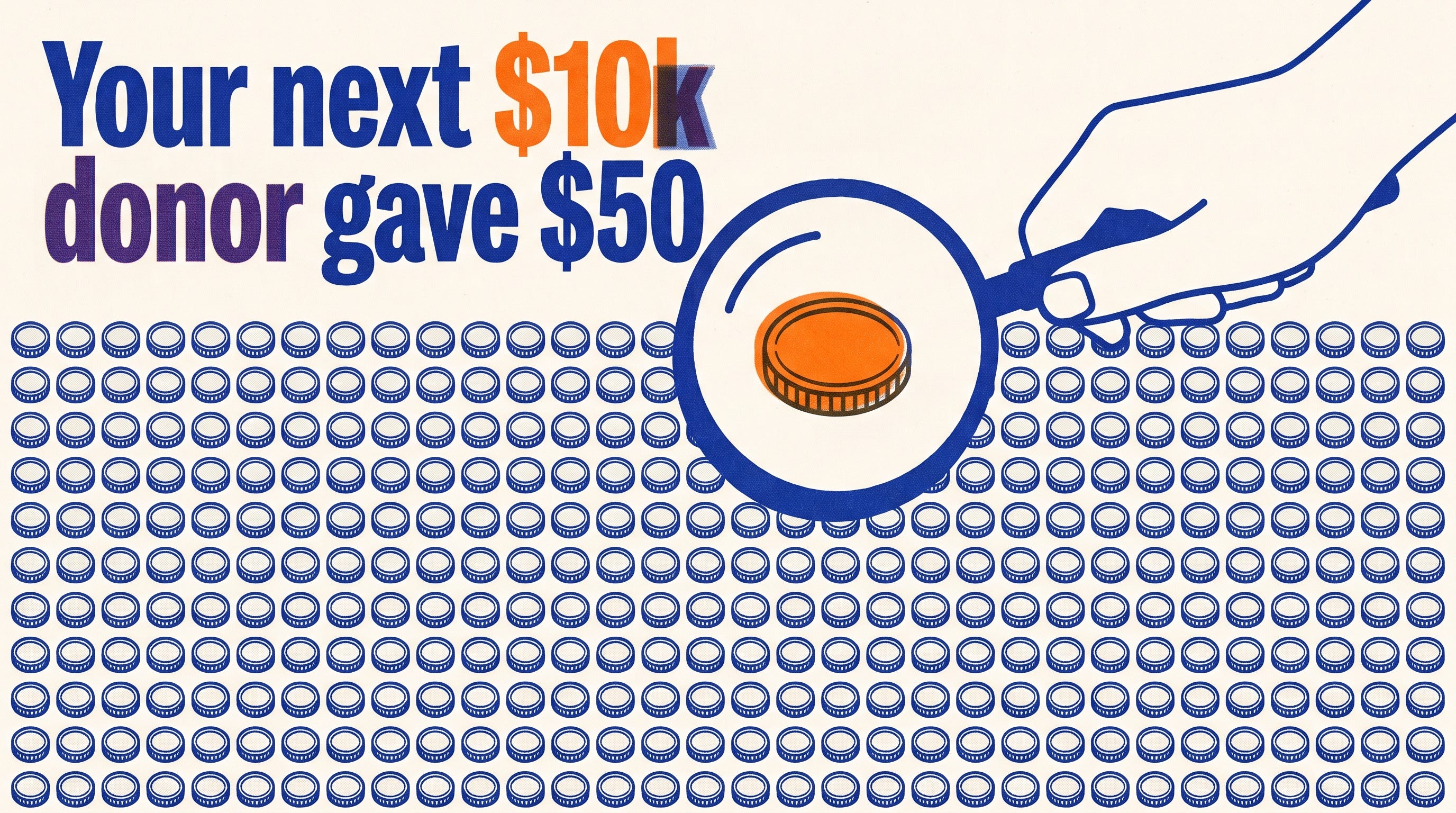
Your big donors are already hiding among your small ones. I was on a call this week with the digital team at one of North America’s largest nonprofit fundraisers, and I keep coming back to something they said. Their data is tuned to converting thousands of small gifts. None of it flags the supporter who looks like a $100 ask but, over a glass of wine, could be a $10,000 gift.
If your file doesn’t tell you that either, you’re not doing anything wrong. Small-donor programs were never designed to find that person, and wealth screening, where it happens at all, looks at assets once a year. The behavioral signals are in the file the whole time - the $50 donor who opens every impact update, asks how a program actually runs, gives in December and to the spring appeal.
Last week Americares announced a record $50 million gift from a Connecticut family who had been involved with the organization for 30 years (AP, Sep 9). Thirty years is a long time to keep paying attention to someone.
Why this is good news
No day of the year brings more of those people through the door. 19.1 million Americans gave money on GivingTuesday last year. Some of the people who give to you on December 1 will have far more capacity than a $25 default ask is ever going to show you.
The tax code helps at the top of the funnel, too. From this year, Americans who don’t itemize can deduct up to $1,000 in cash gifts to operating charities, or $2,000 for married couples. Put that in your campaign copy, itemizers can now only deduct giving above 0.5% of their income, which nudges them toward fewer, larger gifts.
So count your gifts on December 1, by all means. Then ask which of them could turn into a very different relationship, and make sure someone on your team knows by December 2.
Moves this month
Add one question to your GivingTuesday thank-you page. “What made you give today?” The answers will tell you more about a first-time donor than a wealth screen will.
Agree your “golden goose” flag before the campaign, not after. Pick two or three behaviors (a second gift within a year, questions about program detail, an employer match) that take a donor out of the mass email stream and put them in front of a person.
Sign up to our personalization workshop on 23rd September at 11am ET to develop your strategy in more detail.
📣 Join the free workshop: personalized campaigns, unlocked inside your CRM
Wednesday, September 23 · 11am ET · free for everyone in this network
Everything in this issue runs on data already sitting in your CRM. In the workshop we’ll show you how personalized campaigns work and where the signals are, so you can put it into practice in your own organization before GivingTuesday.
And because you’re part of this network, you get access to the tools for free.
Reply to this email with “workshop” and we’ll send your invite. Reading on the web or in the app? Email hello@aifornonprofitsnetwork.org instead.
🧪 From the cohort
Two of the things our six cohort nonprofits are testing are exactly this: fuller supporter profiles, and AI-surfaced match funding. So far the work is less about predicting who is wealthy than noticing who is interested, and getting that in front of a person while it still matters. Results come out in December, failures included.
Cohort two is open: whitelabel.ai/cohort-two
📡 FUNDING RADAR
Humanity AI’s $10M open call is live. We’ve been watching for this since August. It opened September 10 with grants from $75,000 to $1 million for US-based, community-led AI work in education, labor and the economy, and the humanities, arts and culture. Lead applicants need 501(c)(3) status. Applications close October 21 at 4:59pm PT (Humanity AI). Drop us a note if you are thinking of applying - we would like to support - hello@aifornonprofitsnetwork.org
Agreeing the flag before the campaign is the right call, and the part that usually breaks is what happens after the flag fires. A flag with no route attached is just a label in the CRM. Worth deciding in the same sitting: who receives it, within how many days they have to make contact, and what happens if nobody does. Otherwise it goes to a shared inbox on December 2, which is the week nobody is reading shared inboxes. The other thing I would keep manual this first year is the judgment call itself. Let the system surface the candidates and let a person decide who gets a conversation. You learn what the real signal is that way, and by next GivingTuesday you actually have something worth encoding.